
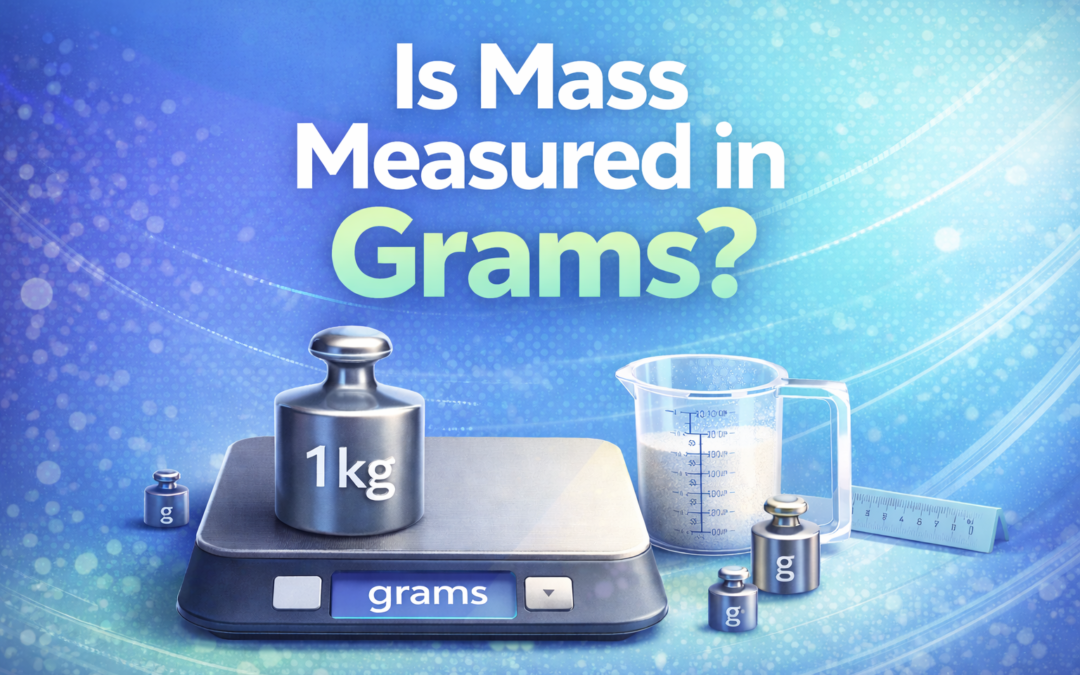
Is mass measured in grams? Yes, mass is commonly measured in grams, especially for smaller objects and everyday applications in the United States and worldwide. When you understand how grams relate to kilograms and how mass differs from weight, you gain clarity in science, nutrition, commerce, and daily measurements.
This guide explains the principles behind mass, why grams are widely used, and how accurate measurement supports better decision-making in both academic and practical settings.
What Mass Actually Means
Mass refers to the amount of matter contained in an object. When you hold a book, a phone, or a bag of flour, you are interacting with matter that has measurable mass. Scientists define mass as a fundamental property that does not change based on location.
You can think of mass as a measure of how much “stuff” an object contains. Even air has mass because it consists of atoms and molecules. This principle explains why sealed containers feel heavier than empty ones.
In physics, mass also reflects inertia. Objects with greater mass resist changes in motion more strongly than objects with less mass. This concept becomes essential when you study forces, acceleration, and energy.
Is Mass Measured in Grams or Kilograms?
Yes, mass is measured in grams, but grams are not the only unit used. In the metric system, grams and kilograms are the most common units for measuring mass. One kilogram equals 1,000 grams, making conversions straightforward and consistent.
You typically use grams for smaller items like food ingredients or jewelry. For larger objects such as people or heavy equipment, kilograms provide a more practical scale. This decimal-based system allows you to move between units simply by multiplying or dividing by 1,000.
When precision matters, you rely on grams because they offer finer measurement increments. In laboratories, even smaller units like milligrams are used for high-accuracy work.
Why Grams Are Used Worldwide
The gram is part of the International System of Units, often called the SI system. This system standardizes measurement across science, engineering, medicine, and global trade. According to international standards updated in 2019, the kilogram is now defined using fundamental physical constants, ensuring extreme precision.
Grams simplify calculations because the metric system operates in base 10. You can easily scale up or down without complicated fractions. This design reduces human error and improves consistency across industries.
In the United States, scientific and medical fields rely heavily on metric mass units. Even if everyday conversations use pounds, official documentation frequently uses grams for clarity and compliance.
Mass vs Weight: The Crucial Difference
Many people confuse mass with weight, but they are not the same. Mass measures the amount of matter in an object, while weight measures the gravitational force acting on that mass. If you traveled to the Moon, your mass would remain constant, but your weight would decrease.
Weight depends on gravity, and gravity varies by location. Mass remains stable whether you stand on Earth, Mars, or in orbit. This distinction is critical in physics, aerospace engineering, and scientific research.
Understanding this difference improves your measurement accuracy. When you see a food label listing grams, it refers to mass, not weight.
How Grams Are Measured in Practice
You measure grams using a scale designed for mass measurement. Digital kitchen scales, laboratory balances, and industrial systems provide readings in grams for accuracy. These devices compare an object’s mass against calibrated standards.
In everyday life, you often encounter grams on nutrition labels. For example, protein, carbohydrates, and fats are all listed in grams to reflect mass. This standardized labeling supports better health tracking and regulatory compliance.
If you have ever wondered about scale readings, you can study more about what a gram weighs on a scale and see how measurement precision works in practical terms. Understanding this concept helps you interpret scale displays correctly and avoid common misconceptions.
Converting Grams to Other Units
Although grams are standard for mass, you sometimes need conversions. For example, recipes, shipping details, or product specifications may require ounces or pounds. Because one ounce equals approximately 28.35 grams, accurate conversion ensures consistency.
When you need quick, reliable results, you can use tools that let you convert grams to ounces instantly without manual calculation. This approach eliminates rounding errors and improves efficiency in both professional and household settings. Conversion tools are especially helpful in cross-border commerce where measurement systems differ.
You should also understand that ounces are part of the customary system. If you question whether that system aligns with metric standards, you can explore insights about is ounces metric and clarify how the two systems interact. This knowledge prevents confusion when interpreting labels or international data.
Common Uses of Grams in Daily Life
Grams appear frequently in cooking, nutrition, and retail. When you measure flour, sugar, or spices, grams provide precise quantities that improve recipe consistency. Professional chefs prefer grams because they offer repeatable accuracy.
In medicine, dosages are often prescribed in milligrams or grams. This precision ensures patient safety and therapeutic effectiveness. Even small miscalculations can produce significant consequences, so clarity in mass measurement is essential.
Retail packaging also relies on grams for transparency. When you buy packaged goods, the listed gram value informs you about the actual quantity of product inside.
Scientific Importance of Measuring Mass in Grams
In laboratory environments, mass measurement supports research integrity. Experiments depend on accurate gram-level readings to produce reproducible results. A slight deviation in mass can alter chemical reactions or material properties.
Scientists use high-precision balances capable of measuring fractions of a gram. These devices operate under strict calibration protocols to maintain reliability. Without consistent mass measurement, experimental outcomes would lack credibility.
You also see grams used in environmental science. Air quality studies, for example, measure particulate matter in micrograms to evaluate public health risks.
The Metric System Advantage
The metric system’s structure simplifies scaling. Because each unit changes by powers of ten, you can shift decimal points instead of calculating complex ratios. This design increases speed and reduces cognitive load during problem-solving.
Educational systems across the United States teach metric mass units early to build foundational understanding. Students learn that 1,000 grams equal one kilogram and apply that knowledge in science and mathematics. This familiarity strengthens analytical thinking.
Businesses benefit from metric consistency as well. International trade depends on standardized mass units to avoid disputes and ensure fair transactions.
Frequently Asked Clarifications
You may still have questions about grams and mass. The following clarifications address common concerns:
- A gram measures mass, not force.
- Weight changes with gravity, but mass remains constant.
- Digital scales often display grams for accuracy.
- Kilograms are used for larger masses.
- Milligrams are used for highly precise measurements.
These points reinforce your understanding and prevent confusion between everyday language and scientific terminology.
Practical Examples for Better Understanding
Imagine you buy 500 grams of coffee beans. That quantity reflects the mass of the beans, independent of where you weigh them. If you traveled to a different planet, the mass would remain 500 grams, but the weight reading would change.
Consider a shipping company calculating freight charges. The company may record mass in kilograms for international documentation while converting to pounds for domestic logistics. Accurate conversion ensures transparent billing and regulatory compliance.
Now think about health tracking. When you monitor nutrient intake, you rely on gram measurements to manage protein or carbohydrate consumption effectively.
Conclusion
Is mass measured in grams? Yes, grams are one of the primary units used to measure mass, especially for smaller objects and precise applications. When you understand the distinction between mass and weight, you gain clarity in science, nutrition, engineering, and commerce.
Grams provide consistency because they belong to the metric system, which operates on simple base-10 principles. Whether you measure ingredients, conduct laboratory experiments, or analyze product labels, grams ensure reliability and accuracy.
By mastering gram-based measurement and understanding how to convert units when necessary, you strengthen your analytical skills and improve real-world decision-making. That clarity allows you to interpret data confidently and apply measurement principles effectively in everyday life.